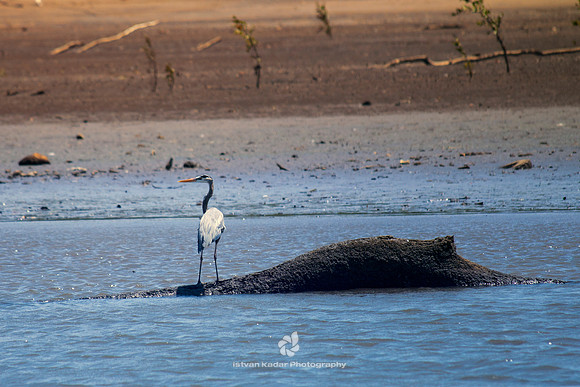
Great Blue Heron
The Great Blue Heron (Ardea herodias) is the largest of Costa Rica's herons and egrets, standing over three feet high. The bill is yellowish, and the head is white with a black stripe behind the eyes extending into black plumes.
Great Blue Herons are present from October through April at ponds, canals, and estuaries along the Caribbean coast from Tortuguero to Cahuita National Park. On the Pacific slope they are found stalking shallow water for fish, small vertebrates, and aquatic invertebrates in wetlands throughout Guanacaste, along the entire Pacific coast.
The primary food for Great Blue Heron is small fish, though it is also known to opportunistically feed on a wide range of shrimp, crabs, aquatic insects, rodents and other small mammals, amphibians, reptiles, and small birds. Herons locate their food by sight and usually swallow it whole. Herons have been known to choke on prey that is too large. It is generally a solitary feeder. Individuals usually forage while standing in water but will also feed in fields or drop from the air, or a perch, into water. As large wading birds, Great Blue Herons are capable of feeding in deeper waters and thus are able to harvest from niche areas not open to most other heron species.
© Istvan Kadar Photography