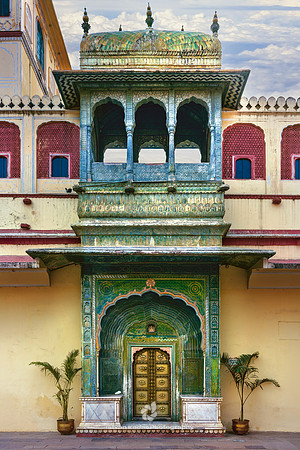
Leheriya Gate, Pritam Niwas Chowk, City Palace, Jaipur, India
The four gateways stand at the four corners of Pritam Niwas Chowk, a courtyard inside Jaipur's City Palace. Richly decorated, each in a different colour and theme, they link the semi-public chowk with the private inner world of the royal family. Despite their completely different designs, patterns and colours, the gates sit in perfect harmony with the courtyard around them — a marvel created by the two principal architects of the Jaipur project, Vidyadhar Bhattacharya and Sir Samuel Swinton Jacob.
Architecturally, the gates blend two traditions: the upper half is Rajasthani, a jharokha balcony with two pilasters and a chhatri, or pyramidal roof, each topped with five bulbous finials, while the gateway below is more Mughal. Though the doors themselves are rectangular with moulded top corners, their grandeur comes from a majestic arch forming a niche, or pishtaq, and a denticular "Dantedaar Mihrab" arch. The gates are clad in glass mosaic tiles, imported by the Mughals from Persia and widely used by the Rajputs in their forts.
The four magnificent doorways depict the four seasons and are dedicated to four Hindu gods.
1. The Lotus Gate represents summer, and is dedicated to Lord Shiva and Goddess Parvati.
2. The Rose Gate symbolises winter, and is dedicated to Goddess Devi.
3. The Lehariya Gate depicts spring, and is dedicated to Lord Ganesha.
4. The Peacock Gate, the most famous among these, represents autumn, and is dedicated to Lord Vishnu.
© Istvan Kadar Photography