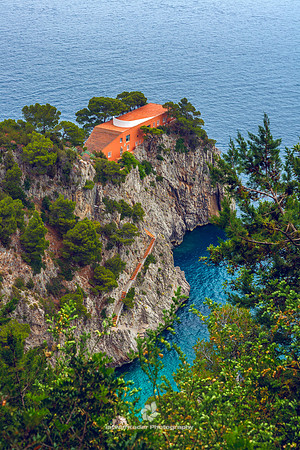
Villa Malaparte, Capri, Italy
The timeless allure of Casa Malaparte, built in 1938 by the architects Curzio Malaparte & Adolfo Amitrano in Punta Massullo on the isle of Capri, is considered to be one of the best examples of modern italian architecture.
Its dominant position on a rocky outcrop reflects the villa's expressive and outward-looking spirit. It is widely regarded as one of the finest examples of modern Italian architecture. The red structure, with its inverted pyramid stairs, sits 32 metres above the Gulf of Salerno. It is completely isolated from civilisation and can only be accessed on foot or by boat. Malaparte's eccentric character eventually led him to take control of the design process, causing serious conflict with Libera. The building could be interpreted as a hybrid of classical and modern architecture, being classical in its imposing monumentality and modern in its domestic, functional scale, offering shelter and control over the surrounding landscape. Built with local stone extracted from the site itself, Villa Malaparte appears to have emerged from the landscape on which it sits. Above the house is a large staircase that leads to a solarium — a new floor that appears to extend towards the horizon. This space is completely separate from the rest of the house and cannot be accessed from inside. It is along this architectural promenade that the monumentality of Villa Malaparte is most clearly manifested.
The staircase serves as a ritual of arrival, revealing the landscape to visitors in all its glory. Following Malaparte's death in 1957, the house was completely abandoned and spent much of the 20th century in a state of disrepair.
In 1961, Jean-Luc Godard shot his critically acclaimed film Le Mépris at Villa Malaparte, starring Brigitte Bardot and Michel Piccoli. In this film, the architecture plays a leading role, becoming closely linked to the plot.
© Istvan Kadar Photography