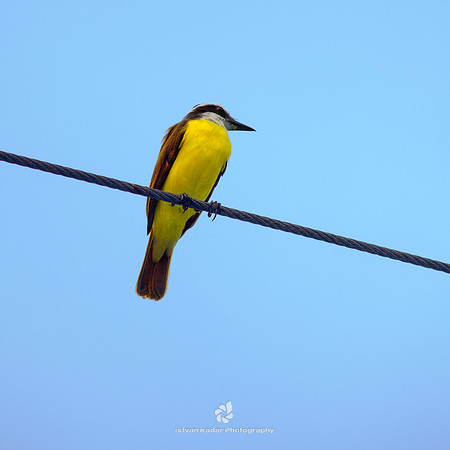
Great Kiskadee
The Great Kiskadee (Pitangus sulphuratus) is a passerine bird. It is a large tyrant flycatcher. It breeds in open woodland with some tall trees, including cultivation and around human habitation. The great kiskadee can be found from extreme southern Texas south to Argentina.
The great kiskadee eats insects like beetles, wasps, grasshoppers, bees and moths. Despite the fact that it is a flycatcher, it also eats berries, seeds, mice, frogs, fish and lizards. It also will dive straight into the water to catch fish.
Kiskadees are monogamous. A male will mate with only one female. Mating season begins in late March. The female great kiskadee lays two to five creamy-white and brown speckled eggs in a domed nest made of sticks, grass, moss and bark. The nest has a single entry hole and is lined with soft material like wool and feathers. The nest is usually built in a thorn tree or bush. Both parents defend the nesting territory and care for the young.
The great kiskadee is named for its loud "kis-ka-dee" call. It travels in pairs and aggressively protects its nesting territory. One of its most feared predators is the coral snake and the kiskadee will stay away from anything that has the same color pattern as the coral snake.
© Istvan Kadar Photography