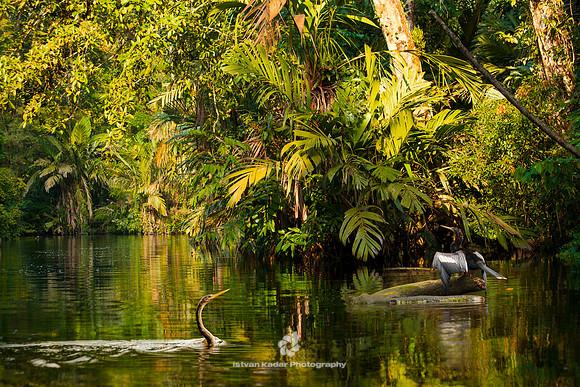
Anhingas in the Canals of Tortuguero
The Anhinga, sometimes called Snakebird, Darter, American Darter, or Water Turkey, is a water bird of the warmer parts of the Americas. It is a cormorant-like bird with an average body length of 85 cm (33 in), a wingspan of 117 cm (46 in), and a mass of up to 1.35 kg (3.0 lb). It is a dark-plumaged piscivore with a very long neck, and often swims with only the neck above water. When swimming in this style the name Snakebird is apparent, since only the colored neck appears above water the bird looks like a snake ready to strike. They do not have external nares (nostrils) and breath solely through their epiglottis.
Anhingas sometimes sit on a rock or a stump, spread its wings out, because it needs to dry its feathers. Most water birds have oil glands on their backs, near their tails, and can spread the oil over their feathers to make them waterproof. But the anhinga cannot oil its feathers.
Flying birds have air sacs in their bodies, connected to their lungs. When these sacs are full of air they make the bird lighter. There is also some air trapped between the feathers. When the anhinga wants to swim under water, with just his head and neck showing, he can let the air out of his air sacs and press his feathers tight against his body to squeeze the air out of them. When he wants to swim on top of the water he can fill his air sacs and raise his feathers to let air get between them.
Among birds, the anhinga is the best fresh-water diver. It goes down quietly and hardly makes a ripple. It finds its food in the water. It eats insects, frog eggs, fish and even small alligators. If an object is too large to be swallowed at once the bird spears it on his beak. Then he comes to the surface and flips it off, catches it and lines it up for swallowing.
Anhingas like to make their nests in trees that hang over water. The male collects sticks and twigs which the female weaves into a nest. 3 to 6 eggs are laid and both parents incubate them. They hatch in about a month. The chicks are blind and naked but soon grow a coat of white down. They grow up so fast that when they are 2 weeks old they know what to do if danger threatens. They simply drop into the water and swim to a hiding place. After the danger is over they climb back to the nest if they can. They don't just go on all four! They use all five; feet, wings and neck, in climbing. If they can't get back to the nest they perch on a rock and their parents feed them there. After they grow their feathers, at 6 to 8 weeks, they are on their own.