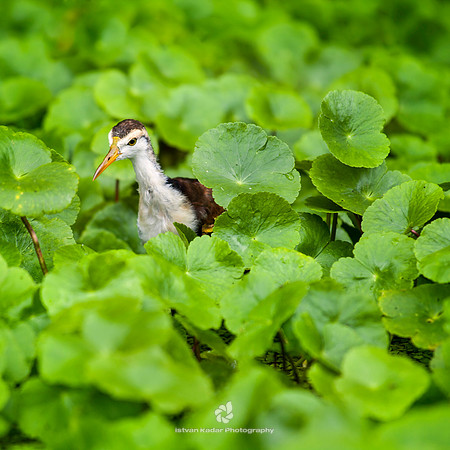
Northern Jacana (Immature)
One of the most common and interesting waterbirds of Costa Rica's shallow marshy wetlands is the Northern Jacana (Jacana spinosa).
The black and rusted body is highlighted by yellow feathers, a yellow bill, a yellow frontal shield on the forehead, and unusual yellow spurs that are briefly visible at the wrist joint of the wings each time the bird alights. The sexes are identical, but the females are about 40 percent larger than the males. Young jacanas are coloured so differently that they almost look like a different species. The back is pale brown, the throat and breast are white, and the cap and back of the neck are dark brown.
The jacana has extremely long toes and toenails that enable it to walk on lily pads and other floating vegetation as it searches for aquatic insects and other invertebrates, tiny fishes, snails, and water lily seeds that have been exposed by Purple Gallinules. The most unusual feature of the jacana is that the females are polyandrous. Each female defends a marshy area that contains one to four males. She mates with all of them, and each male incubates four eggs on small, wet, floating platforms of aquatic vegetation. The female defends the male as he incubates the eggs, but the male raises the young after they hatch.
The Northern Jacana is readily seen in shallow wetlands of both coasts and marshes of Central Plateau. It is common in Tortuguero, Carara, and Palo Verde National Parks.
© Istvan Kadar Photography