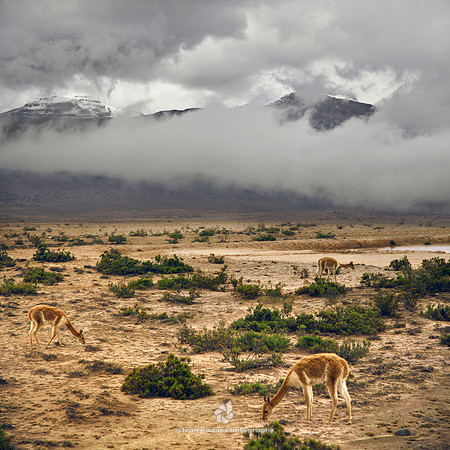
Wild Vicuñas
Vicuñas are found on the high grasslands and plains (between 3,000 - 5,000 meter / 10,000 - 17,000 feet) of the Andes Mountains. It is a relative of the llama, and is now believed to share a wild ancestor with domesticated alpacas, which are raised for their fibre. Vicuñas produce small amounts of extremely fine wool, which is very expensive because the animal can only be shorn every 3 years. When knitted together, the product of the vicuña's fur is very soft and warm. It is understood that the Inca valued vicuñas for their wool, and that it was against the law for any but royalty to wear vicuña garments.
Both under the rule of the Inca and today, vicuñas have been protected by law. Before being declared endangered in 1974, only about 6,000 animals were left. Today, the vicuña population has recovered to about 350,000, and while conservation organizations have reduced its level of threat, they still call for active conservation programs to protect population levels from poaching, habitat loss, and other threats.
© Istvan Kadar Photography